
Pixel pitch explained: P2.6, P3.9 and what you actually need
Every LED wall quote leads with a number like P2.6 or P3.9. It is the single spec that decides whether your guests see a picture or a grid of dots — and a smaller number is not automatically the right answer.
What the number means
Pixel pitch is the distance in millimeters between the center of one LED pixel and the center of the next. P2.6 means 2.6 mm apart. That is the whole definition. Everything else people say about pitch is a consequence of it.
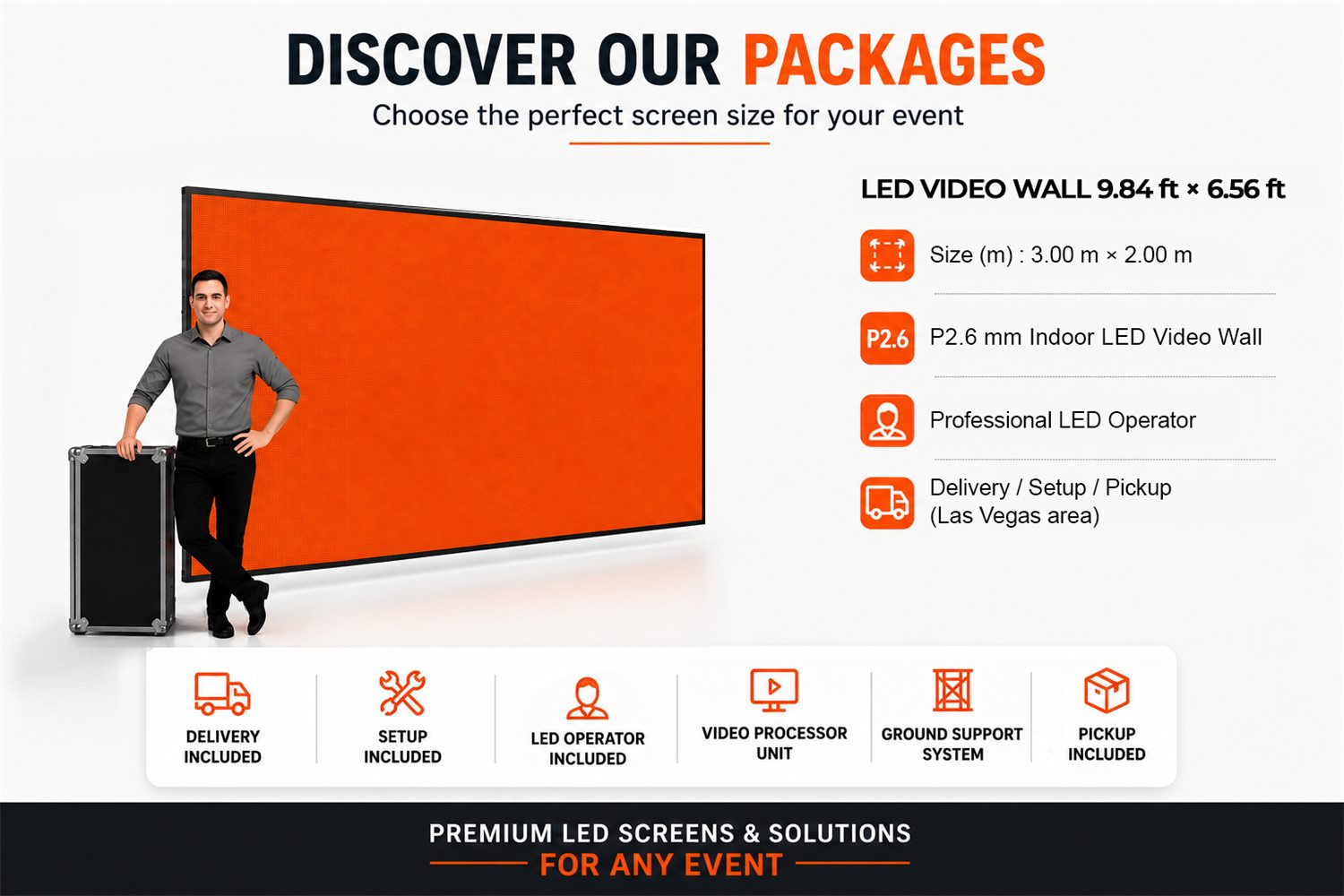
Smaller pitch means pixels packed closer, so more of them per square meter, so more resolution in the same physical area — and a picture that holds together when you stand close to it. A 3 × 2 m wall at P2.6 carries roughly 1152 × 768 pixels. The same wall at P3.9 carries about 768 × 512. Same physical size, noticeably different picture.
The rule that actually matters: minimum viewing distance
There is a rough industry rule of thumb that gets you most of the way:
Comfortable minimum viewing distance in meters ≈ the pitch number
P2.6 looks clean from about 2.6 m back. P3.9 wants about 3.9 m. Closer than that and the eye starts resolving individual pixels, and the image reads as a grid instead of a picture.
| Pitch | Clean from | Typical use |
|---|---|---|
| P1.5–P1.9 | ~2 m | Broadcast sets, permanent lobby installs, boardrooms |
| P2.6 | ~2.6 m | Indoor events, weddings, DJ booths, ballrooms, trade show booths |
| P3.9 | ~4 m | Larger indoor stages where nobody stands at the screen |
| P6–P10 | 6–10 m | Outdoor festival screens, arena scoreboards |
Now apply it to a real event. At a wedding or a gala, guests do not politely stay 4 m from the screen — they stand at the DJ booth, they take photographs directly in front of the wall, they lean on the stage. That is why we stock P2.6 indoor panels for event work. It is the pitch that survives a photograph taken from a meter away, which is where a lot of this content ends up.
Why a smaller number is not always better
If P1.5 is sharper, why not use it everywhere? Three reasons, and they are all practical rather than technical.
1. Cost climbs steeply
Halving the pitch roughly quadruples the number of LEDs in the same area. Fine-pitch panels cost several times more per square meter to rent, and the difference buys you nothing if nobody stands close enough to see it.
2. Fragility
The finer the pitch, the more delicate the LED surface. At a wedding with an open dance floor — a wall people will lean on and touch — robustness is worth more than a resolution figure nobody can perceive from where they are standing.
3. The content is usually the limit, not the panel
Most event content is 1080p video, phone footage or a slide deck. On a 5 × 2 m P2.6 wall you already have more physical pixels than a 1080p source can fill. Going finer just scales the same source across more LEDs — you do not gain detail that was never in the file.
Indoor versus outdoor is a different spec
Pitch and weatherproofing are separate things, and they get confused constantly. An indoor panel is built for controlled light and has no meaningful ingress protection. An outdoor panel is sealed, rated for rain, and runs at far higher brightness — typically 4,000–6,000 nits against 800–1,500 for indoor — because it is fighting daylight.
Put an indoor wall outdoors in Las Vegas daylight and it will look gray and washed out, quite apart from the weather risk. Put an outdoor wall in a ballroom at full brightness and it is genuinely uncomfortable to look at. Neither is a pitch problem.
The specs worth asking about instead
Pitch dominates the conversation, but if you are comparing two quotes, these tell you more:
- Refresh rate — anything under 1,920 Hz will band and flicker on camera. If a videographer or a live stream is involved, this matters more than pitch.
- Brightness and color calibration — panels from different production batches drift apart. A rental house that calibrates its stock gives you an even wall instead of a patchwork.
- Processing — the video processor decides how your source is scaled and whether it holds up. A good panel behind a poor processor still looks poor.
- Spare panels on site — LED panels are modules. A crew that brings spares can swap a failed tile in minutes. A crew that does not, cannot.
- Is an operator included? — someone who stays with the wall, loads content and fixes problems during the event, rather than handing you a laptop.
All of those come as standard on our LED wall rentals, which is less a boast than an admission that a wall without them is not really a service.
The short version
For an indoor event in Las Vegas where guests will get close to the screen — a wedding, a DJ booth, a gala, a trade show booth — P2.6 is the sensible answer, and paying for finer is usually paying for something nobody can see. If your audience is genuinely 10 m back on a large stage, a coarser pitch buys you a bigger canvas for the same money, which is almost always the better trade.
If you are unsure, tell us the room and where people will stand. That question answers the pitch question by itself.