
How much PA do you actually need? Sizing sound by guest count
Two speakers on sticks will not cover four hundred guests, and a full line array is overkill for eighty. A practical guide to sizing a system by the room, the headcount and what is happening on stage.
Guest count is the starting point, not the answer
Headcount gets you into the right bracket. Then three other things move you within it: the shape of the room, what the room is made of, and what is producing the sound.
| Guests | Typical system | Covers |
|---|---|---|
| Up to 100 | 2 tops on stands, 1 sub | Speeches, background music, a small DJ set |
| 100–250 | 2 tops, 2 subs, 1–2 monitors | DJ and dancing, a solo act, a ceremony |
| 250–500 | Line array, 4–6 modules per side, 2–4 subs | Live band, a full dance floor, a long room |
| 500–1000 | Line array, 6–8 per side, 4+ subs, delay fills | Ballroom concerts, large corporate events |
Treat those as an opening position. What follows is what moves them.
The room matters more than the headcount
Shape
Four hundred guests in a wide, shallow ballroom is a completely different problem from four hundred in a long, narrow room. A wide room needs horizontal coverage — often a wider array or additional fill speakers at the sides. A long room needs to throw distance without deafening the front, which is exactly what a line array is designed for. Past about 30 m, you add delay speakers partway down the room, time-aligned so the back of the room hears one sound rather than an echo.
Surfaces
Carpet, drape and full tables absorb sound. Glass, marble, hard floors and high ceilings reflect it, and reflections are what turn a room to mush. A hard-surfaced venue needs tighter directional control, not more power — adding volume in a reflective room makes it worse, not better.
Ceiling height
Low ceilings limit how high you can fly the system, which limits how far it throws before the front row is uncomfortable. In a low room, more, smaller sources spread around the space beat one loud source at the front.
What is on stage changes everything
- Speeches only — you need intelligibility, not power. A modest system, well placed, with good microphones. Most speech systems fail on microphone technique and feedback, not on wattage.
- DJ — you need low end. The dance floor is a subwoofer question. Two tops with no sub is the single most common under-spec at weddings.
- Live band — you need mains, subs, and stage monitors so the band can hear themselves. A band without monitors plays louder and louder trying to hear, and the front-of-house mix loses the argument.
- Ceremony outdoors or in a second room — that is a separate system, not a longer cable. Budget for it as its own line.
Why line array, and when it is overkill
A conventional pair of speakers is a point source: it is loud where you stand near it and drops away sharply with distance. To make the back of a long room comfortable, you push the front row into discomfort.
A line array is a column of modules aimed as one system. The coverage pattern is designed so the level from the front of the floor to the back wall stays within a few decibels. In practice that means people at the back hear the show, and people at the front can still talk between songs. In a room over about 25 m long, or over roughly 250 guests, that is worth real money.
Below that, an array is more rigging, more weight and more cost for a benefit the room is too small to show. We will say so.
The parts of a system, and what each one is for
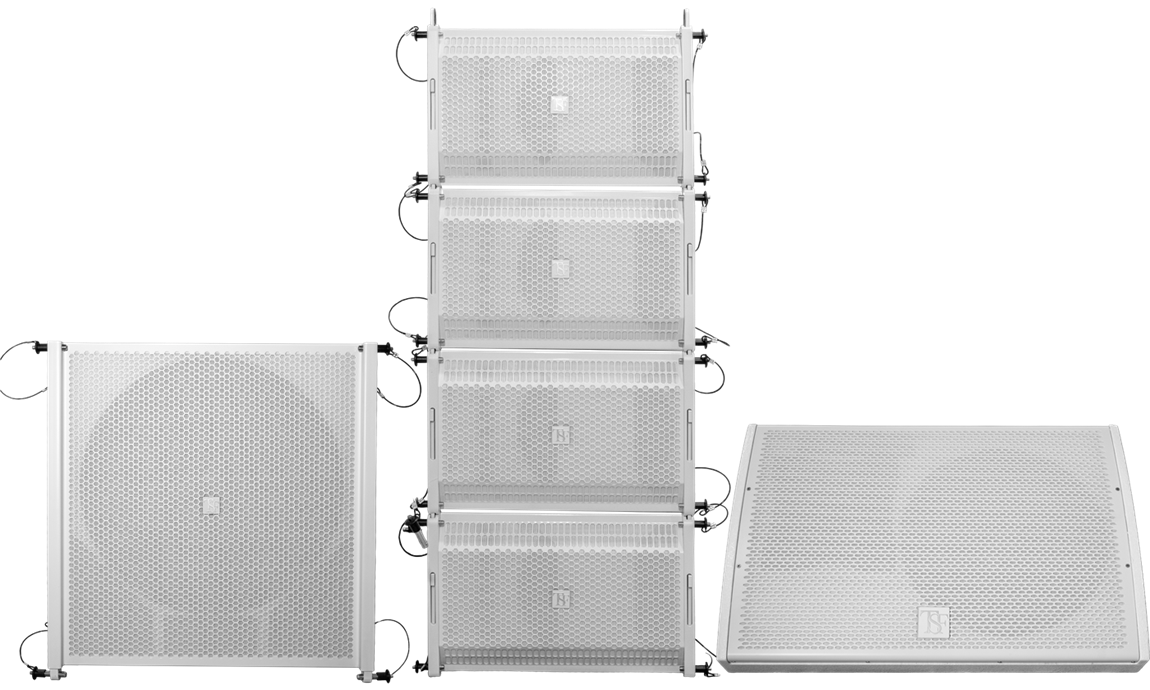
- Mains — the main left and right hangs or stacks. Everything the audience hears comes through these, which is why the driver inside the box matters more than the badge on the outside. Ours are TSF line array cabinets loaded with LaVoce Italiana woofers and compression drivers.
- Subwoofers — everything below roughly 100 Hz. Kick drum, bass, and the part of a dance track people feel.
- Stage monitors — wedges pointed back at the performers so they hear themselves.
- Front fills — small speakers at the stage lip for the first two rows, which usually sit under the main coverage.
- Mixing console — where it is all balanced, at front of house, out in the room rather than off to the side.
- Microphones — wired for instruments, wireless handhelds and lavaliers for speeches. In Las Vegas, wireless frequency coordination genuinely matters; hotels are congested.
- System tech — the person who tunes it to the room and stays with it. The difference between equipment and sound.
Tuning is not a formality
Two identical systems in two rooms need different settings. Tuning means measuring the room and correcting for what it does — the boom a hard wall adds, the dead spot behind a pillar, the delay between the mains and the fills. It happens before doors, with the room dressed as it will be.
A system delivered but not tuned is a rental. A system tuned to the room is a service, and it is why we send a tech rather than a truck.
What to tell us
Four things and we can spec it accurately: the venue and room name, the guest count, what is happening on stage, and whether there is a second location like an outdoor ceremony. If you know the ceiling height and whether the room is carpeted, better still.
Our cabinets are white, which matters more than it sounds — speakers are the one piece of production kit that cannot be hidden behind drape, so in a light ballroom they land in every wide photograph.
The finish is the visible part; the sound is the part we care about. Sound quality is very important to us, so the cabinets are high-grade boxes manufactured in China to a professional touring standard, and every one of them is loaded with drivers from LaVoce Italiana, the renowned Italian transducer maker. That is what keeps a line array clear at conversation level and still full at the back of a six-hundred-seat room.